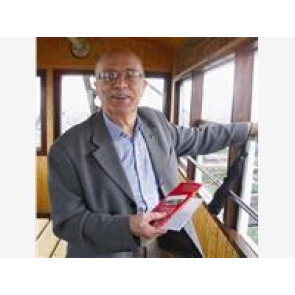
WILLIAM (BILL) SIMCOCKMoorlands teacher William Holden Simcock had a passionate commitment to many causes, including music, drama and Esperanto.He died, aged 89, on November 5, 2008, at the Douglas Macmillan Hospice, Stoke-on-Trent.Bill lived at Butterton, Staffordshire, and for 22 years until retirement he was headteacher at Manifold Primary School, Warslow, Staffordshire.His father was a master builder, and Bill was one of five children brought up at Ricardo Street, Dresden.He was educated at Longton High School, and 67 years after leaving he founded an association of his school contemporaries, which still flourishes.A sergeant in the Royal Artillery during the Second World War, Bill served in Germany and Belgium. Afterwards, he trained as a teacher, and graduated in English from Keele University.Before being appointed to the school at Warslow, he taught at a number of schools in North Staffordshire, and he retired in 1979.For many years, Bill was chairman of Butterton Parish Council.He played the organ at the parish church at Butterton, and also successively at local Methodist churches, Wetley Rocks parish church and Leek Baptist Church.He followed his father as a lay preacher, and he also produced an account of Primitive Methodism in North Staffordshire.He held several posts in the Wetton and Longnor Methodist circuit until its demise.But in 1985 he was disillusioned with the Christian faith and became a Humanist. He was a founder member of the North Staffordshire and South Cheshire Humanist Association.An ardent campaigner for what he thought to be justice and social betterment, he wrote many letters to the media on subjects ranging from support for the National Health Service to vegetarianism.Bill always regarded drama as his greatest achievement. During the late 1940s and 50s, he appeared in, or directed, most of Shakespeare's plays at several local venues, including acclaimed performances as Hamlet and Iago.He was a founder member of a spin-off group from Stoke-on-Trent Shakespearean Society, Triganta Modern Plays, and he took leading roles in many productions, including plays by Bernard Shaw.In retirement, Bill devoted himself to teaching the international Esperanto language. He worked for the movement at home and abroad, firmly believing in its potential contribution to international peace and understanding.For more than 20 years he taught the language in correspondence courses.His commitment took him to 17 cities throughout the world to attend the annual congress of the Universal Esperanto Association.His passion for Esperanto arose as he noted the immense cost in time and money at international events where information has to be translated to and from many languages.He translated many classical items of English into Esperanto, and spent much of his time writing for journals in the language. He gained the Diploma of the British Esperanto Association and became an honoured Fellow of the association.At the request of Stoke-on-Trent City Council, Bill wrote a biography of a late lifelong friend, Horace Barks, a former Lord Mayor and also an Esperantist.Bill was survived by his wife Muriel, to whom he been married for 61 years. They had four sons, two daughters, and there are four grandchildren.The funeral took place on November 11, 2008, at Carmountside Crematorium.
Keep me informed of updates