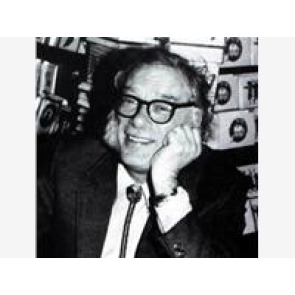
ISAAC ASIMOVIsaac Asimov, who died on 6 April, 1992, aged 72, was one of the 20th century's great thinkers - and of those, his mind knew the least limits.He was best known as being among the major science fiction authors of his era and penned some of the genre's most influential works.But as well as the future histories he constructed for his fantastical stories, he also documented the real histories of science from its earliest stages to the present day in an accessible and personal way.He was responsible for more than 500 books, including novels, short story collections, scientific nonfiction, literary criticism, theological study and autobiography, and was also known as a prolific letter-writer.He was born in the Russian territory of Smolensk Oblast between 1919 and 1920, the uncertainty of his birth date being down to differences between Gregorian and Hebrew calendars. When he was three his family moved to New York where they opened a chain of candy stores. Isaac could read and speak both English and Yiddish by the age of five.After reading science fiction magazines in his parents' shops as a young teen, he began writing stories of his own and had been published regularly before he turned 20. He studied at Columbia University, served in the US Army during the last nine months of World War II and then became an academic at Boston University's School of Medicine.By the late 1950s his income from writing was greater than that from teaching and he concentrated on the former from there on in.Within his vast catalogue of work, Asimov was best known for his 'Foundation' series, a far reaching chronicle of the battle between science and religion on a human planet, which was begun in 1951 as a trilogy and ended up as seven books by Asimov, the last published posthumously in 1993, and another three written after his death by other authors.Within the same fictional universe as Foundation, the events of his 'Robot' and 'Galactic Empire' trilogies also take place. In the Robot books and several short stories, Asimov's 'Three Laws of Robotics' occupy a central place and have had influence not only within science fiction, but also in the field of robotics itself.The Laws govern a robot's behaviour towards humans and in story collections like I, Robot (1950) and The Bicentennial Man (1976) - both of which formed the basis of blockbuster films - they become an elaborate metaphor for the parent-child relationship.He also wrote several independent series of books that fell outside the Foundation cannon, including some mystery stories set in the real world. Isaac Asimov's writing was known for its straight-forward, plot-driven style with a focus on humanity's struggles with science and technology (rather than aliens as in much other sci-fi).Among his innumerable accolades are eight Huge Awards, three Nebula Awards and the title of the greatest ever science fiction short story from the Science Fiction Writers of America for his early work, Nightfall (1941).
Keep me informed of updates