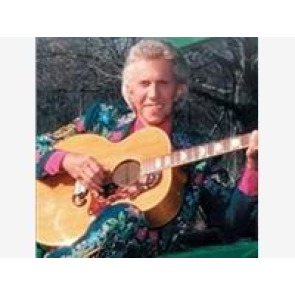
PORTER WAGONERWith his spangled suits, broad grin and cherished songs, Porter Wagoner, who died on 28 October, 2007, aged 80, was the very model of a country star.
Known as the ‘Thin Man From West Plains’, Mr Wagoner built a reputation as a consummate showman and recording artist but also stayed close to his roots with a lifelong patronage of the Grand Ole Opry radio programme and venue.
His syndicated television show ran for two decades, he scored three number one hits and won four Grammys. He was also responsible for launching Dolly Parton into stardom.
Porter Wayne Wagoner was born on 12 August, 1927, in the Ozark Mountains of Missouri. His parents were of Irish-German descent and raised him on a farm. From a young age he would listen to country music on a battery radio.
He first visited the Grand Ole Opry in 1949 to see Hank Williams who would be a massive influence on his style. By the following year he was performing on local radio which led to him being signed by Missouri’s KWTO station.
He made his first recording in 1952, with a version of Williams’ Settin’ The Woods On Fire. He began developing his song-writing around this time and Carl Smith had a hit with Mr Wagoner’s song Trademark (1953). He began touring with the Porter Wagoner Trio (Don Warden on steel guitar and Herschel ‘Speedy’ Haworth on electric guitar) and Company’s Comin’ reached the top 10.
The following year he reached number one with A Satisfied Mind which topped the charts for four weeks. By 1957, with a string of hits behind him, he fulfilled a boyhood ambition when he became a member of the Grand Ole Opry. His outfits – vibrant, rhinestone-encrusted suits by the famous designer Nudie Cohn – complimented his light-hearted, jovial stage presence.
He popularity on the radio show led to The Porter Wagoner Show which first broadcast in 1960 and ran until 1981 on television networks across the United States. Almost 700 episodes were made and the show had an average audience of more than three. The show was one of the key factors in popularising country music during the era.
Mr Wagoner and guests would perform individually and together and he would frequently duet with Pretty Miss Norma Jean. When Jean left the show in 1967, she was replaced by 21-year-old rising star Dolly Parton. The pair became a popular double act with numerous hits, and Mr Wagoner helped guide Parton through her early career.
During the 1960s and ’70s he enjoyed consistent success, with Misery Loves Company (1962) and Please Don't Stop Loving Me (1974, with Dolly Parton) reaching number one in the Billboard charts and Sorrow on the Rocks (1964), a defining version of Green, Green Grass of Home (1965) and The Cold Hard Facts of Life (1967) among his many top 10 successes. In total, 81 Porter Wagoner singles reached the charts.
Mr Wagoner was also notable for his efforts to break down racial barriers in country music. He booked James Brown to play on the Grand Old Opry stage and produced an album for soul musician Joe Simon. He found the criticism he received for this strange. "There is such a similarity between black music and country music," he said.
He retired from touring in 1976, but continued to work with various groups and promoting the Grand Ole Opry. He made his film debut with a cameo in Clint Eastwood’s country music film Honkytonk Man (1982) and also did more television presenting work in the 1990s.
He was inducted into the Country Music Hall of Fame in 2002. In 2004 he came out of retirement to begin a series of award-winning gospel albums. His last album, Wagonmaster, a sophisticated and mournful country record, was released in June 2007. The album and accompanying tour was well received by critics.
He was married twice, to Velma Johnson for less than a year in 1943, and then to Ruth Olive Williams from 1946 to 1986, though they separated 20 years before the divorce. He was survived by his three children, Richard, Denise and Debra.
Keep me informed of updates