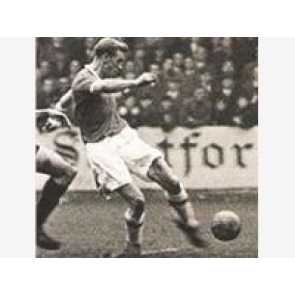
TOMMY JOHNSTONTommy Johnston, who died on 4 September, 2008, aged 81, was Leyton Orient's all-time top scorer and once voted the club's greatest ever player.
He was one of the great footballing journeymen, playing for no less than eight professional clubs during a 12-year career, never staying in one place for more than two years.
But in two spells for Orient he got a total of 123 goals in 190 games. During the 1957/58 season he scored 35 goals for the O's despite moving to Blackburn Rovers towards the end of the campaign. He helped the Lancashire club earn promotion with a further eight goals which confirmed him as Division Two top-scorer.
He also played for Kilmarnock, Darlington, Oldham Athletic, Norwich City, Newport County and Gillingham. He scored 258 goals in 431 league games during his career.
Thomas Bourhill Johnston was born on 18 August, 1927, in Loanhead, a mining village near Edinburgh. He worked in the pits as a youngster.
He began his career playing with local amateur sides until Kilmarnock signed him up at the age of 22. After two seasons he moved south of the border to Darlington. In 1952 he signed for Oldham but in just five games he did enough to impress Norwich City's scouts and he made yet another move.
At Newport County between 1954 and 1956 he enjoyed his best scoring so far in the Third Division with 46 goals in 63 games. In February 1956 Orient signed him for £4,500 plus another player. He scored on his debut and also got the goal that saw Orient clinch that season's Division Three Championship.
He continued his scoring exploits in the Second Division and Blackburn signed him to boost their charge into the top flight. He performed well in the First Division but lost his place to younger players. After less than a year, he returned to the London club where he resumed his role as their leading striker.
He ended his professional career with a season at Gillingham and also played for Folkestone Town in Kent. After retiring he moved to Poulton-le-Fylde in Lancashire and opened a betting shop before emigrating to Australia in 1972.
In 1999 he came top of a poll of supporters to find the greatest player ever to represent Leyton Orient. Shortly after his death the club announced plans to rename their South Stand in his honour.
Keep me informed of updates