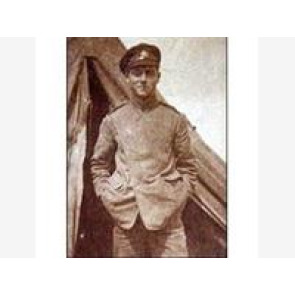
WILLIAM YOUNGwho died on 24 July 2007 aged 107 was a former member of the Royal Flying Corps and one of the last known veterans of the First World War.He enlisted in the British Army in January 1918, shortly after celebrating his 18th birthday. As a radio operator he was responsible for helping aircraft to locate exactly where enemy bases were, in order for them to be destroyed.Once the aircraft had spotted possible enemy locations Young pinpointed the exact location on a map. This was a well known tactic for ensuring that the eventual attack proved accurate.Gunner pilots became used to hearing Young dictate instructions to them and he became a respected member of the RFC during the latter stages of the Great War.William Alexander Smillie Young was born on 4 January 1900 in Lanarkshire. The eldest of six children, at 13, he moved with his family to Middlesex, after his father secured a role as a factory manager.Settling in to life in England, Young attended a county school in Southall, and joined a scheme set up by the Secretary of State of War, Lord Derby that prepared young men for the challenge of army life before their 18th birthday.Young finally entered the army on his 18th birthday after visiting a recruitment centre in Shepherds Bush and signing up to the Royal Flying Corps (RFC).After a successful induction he was ushered off for training in Farnborough where he learnt about aerial observation and wireless communication. He was deployed to France in June 1918 as a member of the 14th Brigade Royal Horse Artillery and assigned to the role of Corporal radio operator.Once in France, Young helped to translate information received from observation aircraft that were monitoring enemy activity and then guided the aircraft using mapping and Morse code to the enemies’ exact location.Young remained in France until an armistice was reached on November 11 1918, although any cause for celebration was short lived when he contracted influenza following the climax of the war.After fully recovering, he saw out his service with the army until August 1919, returning soon after to Britain to study Chemistry at East London College.Moving abroad to Borneo with his young family to become manager of a tanning company he was based in South East Asia, when Japanese forces attacked Pearl Harbor in 1941. Worried for his family’s safety he encouraged them to escape to Australia.Having been unable to escape with them, he was captured by the Japanese in 1942 after they took control of Borneo and for the next three years was forced to live in a camp.Young was finally reunited with his family in Borneo and after the threat of further violence had been exacerbated Young continued his previous role as manager of the tanning factory.He eventually relocated to Australia working at a tanning factory near Perth until his retirement at the age of 70.In 1998, the French government recognised Young’s achievements in the First World War and along with fellow veterans he was awarded the Legion d’honneur. When British Royal Flying Corps veteran William Roberts passed away in 2006, Young became the last known survivor of the original RFC.
Keep me informed of updates