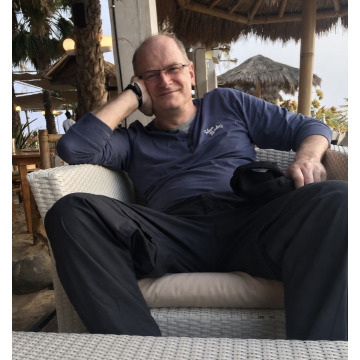
Alan PhilipMEUDELLof Penallta Road, Ystrad Mynach, who passed away peacefully on 29 June 2026, aged 68.
Alan was the adored civil partner of Bethan, who was by his side when he died. He was the beloved brother of John, David and the late Roger Meudell, and a much-loved uncle to Georgina.
Just five months earlier, Alan had been diagnosed with oesophageal cancer. Sadly, as is often the case with oesophageal cancer, his diagnosis came at an advanced stage when treatment options were limited. During the final three weeks of his life, Alan received outstanding care on Penallta Ward at Ysbyty Ystrad Fawr, Ystrad Mynach. His family cannot thank the staff enough for the compassion, dignity and dedication they showed during his time there.
Formerly of Cefn Road, Blackwood, Alan was born in 1958, the youngest child of the late Gwendoline Meudell (née Downing) and the late Thomas Meudell. He attended Blackwood Infants and Junior Schools, followed by Pontllanfraith Grammar School, before completing his training in electronics at Dundee Skillcentre in 1983, specialising in television and radio servicing. He later gained a master's degree in Electronics Technology Management from the University of Glamorgan in 2003.
Alan often reflected that his working life had consisted of two distinct chapters. The first was his career as an electronics service engineer, which took him to Portsmouth during the early-to-mid 1980s before returning to South Wales, where he worked until the early 2000s.
Following a significant deterioration in his mental health, Alan's career, and ultimately his life's work, took a very different direction. Over the next 26 years, he devoted himself to mental health campaigning, advocacy and research in Wales and beyond. He believed passionately that people with direct experience of mental health difficulties should not simply be consulted but should be genuine partners in shaping the services and research that affected their lives.
This commitment led Alan to become a member of the National Institute for Health and Care Excellence (NICE) Guideline Development Group on Depression, a Fellow of the European Patients' Academy (EUPATI), as well as Lay Lead for Partnership in Research (PÂR) at the National Centre for Mental Health, Cardiff University. He also served as Chair of Trustees at Caerphilly Borough Mind, was a member of Mind Cymru's Pwyllgor, and was a Tenant Board Member of United Welsh Housing Association.
Through these and many other roles, Alan helped shape national guidance, health policy and research, remaining steadfast in his belief that the voices and experiences of people living with mental health difficulties should be central to the services and research that affected their lives.
Away from his work and activism, Alan found joy in life's quieter moments. He adored animals, especially the cats who shared his home with Bethan - Smokey, Mini Beast and Tiny - as well as the foster cats and kittens they cared for together. He found great joy in cooking for family and friends. He loved spending time in his garden and in nature, as well as travelling, immersing himself in local cultures and cuisine.
Alan was a gentle, thoughtful and deeply compassionate man whose kindness extended as naturally to the people and animals around him as it did to his life's work. Remarkably humble and selfless, he did not wish for a formal funeral service. He will be cremated locally in South Wales, surrounded by the love of his immediate family, before being interred at Usk Natural Burial Ground, where he will rest alongside his late mother, brother and extended family.
One of Alan's final contributions to mental health research explored end-of-life care for people living with mental health difficulties (readers interested in learning more will find details of the research below). This research found that the way mental health and palliative care services are organised often creates significant barriers to recognising and meeting the complex end-of-life needs of people with mental health difficulties. During Alan's final months, those findings became deeply personal.
For that reason, it feels especially fitting to invite donations in Alan's memory, in lieu of funeral flowers, to support the Clinical Psychology and Counselling Service at Velindre Cancer Centre.
The service was invaluable in supporting Alan as someone living with long-standing mental health difficulties while facing a terminal diagnosis. It helped him make informed decisions about his care, cope with chemotherapy that he found traumatic, come to terms with his diagnosis, and explore what living while dying could look like. Importantly, the service is funded entirely through charitable donations to Velindre Cancer Centre Charity rather than through NHS funding, and any contribution made in Alan's memory will help ensure that others receive the same compassionate support that meant so much to him.
Readers interested in Alan's contribution to mental health research and end-of-life care for people with mental health difficulties, may wish to explore the following publications:
Edwards, D., Anstey, S., Coffey, M., Gill, P., Mann, M., Meudell, A. and Hannigan, B. (2021). End of life care for people with severe mental illness: Mixed methods systematic review and thematic synthesis (the MENLOC study). Palliative Medicine. Available at: doi.org/10.1177/02692163211037480
Hannigan, B., Edwards, D., Anstey, S., Coffey, M., Gill, P., Mann, M. and Meudell, A. (2022). End-of-life care for people with severe mental illness: The MENLOC evidence synthesis. NIHR Health and Social Care Delivery Research. Available at: doi.org/10.3310/ULTI9178